You have products sold by the unit, but that need to be purchased in multiples — for example, an item should be ordered as a case of 12, not as 7 or 10 units.
With the Sold in Multiples feature, you can require that a product only be ordered in fixed quantity increments, while still managing pricing and inventory by the unit.
Who this is for
Anyone who wants to prevent partial-case (or partial-pack) orders on a sellable product — for example, a producer whose ERP or accounting system manages inventory strictly in units, but who physically ships in cases.
How it works
"Products" module: Create your unit-based products and set the price per unit.
"Availability" module: Set the multiple
- On a sellable product, set a "Sold in multiples of" value — for example,
6.
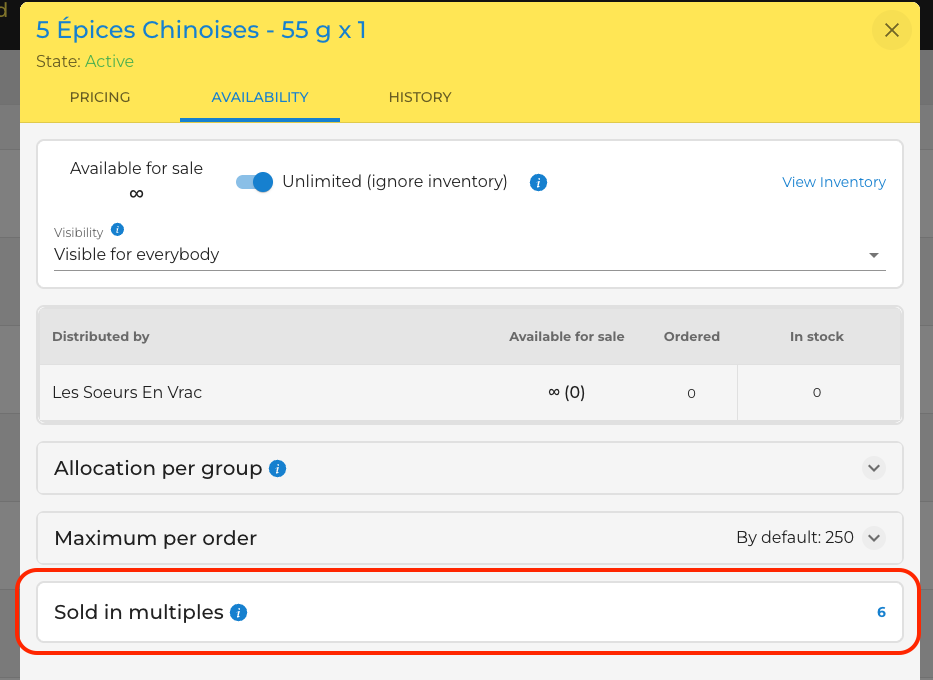
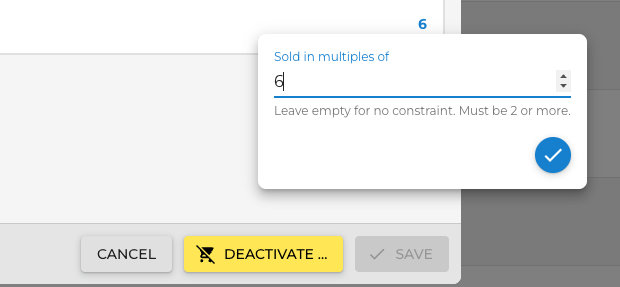
Once this value is set:
- The product can only be ordered in multiples of that number: 6, 12, 18, 24, and so on. Any other positive quantity is rejected.
- The multiple also acts as the minimum orderable quantity — a retailer can't order fewer than one multiple (for example, 1 to 5 units when the multiple is 6). This is a separate rule from the per-order minimum, a different setting covered in a related article.
- If no multiple is set, the product behaves exactly as it does today — no change in behavior.
Where the rule applies
The multiple is enforced everywhere a quantity can be entered for the product, for both retailers and agents:
- The Marketplace
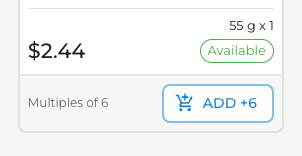
- The order form
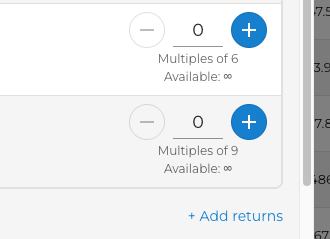
In both places, the product page clearly indicates that the product is sold in multiples only, and shows the multiple.
Ordering experience
The quantity +/- buttons step by one full multiple at a time. For a product sold in multiples of 6, clicking + moves the quantity from 6 → 12 → 18, and so on. Clicking - moves it back down the same way. Decreasing below the lowest multiple (6 → 0) removes the line from the cart or order, just as it does for products without a multiple set.
FAQ
Does this affect pricing? No. The multiple only controls orderable quantities. The unit price is unaffected — a case of 12 is still priced as exactly twice a case of 6, for example.
Does this replace the per-order minimum? No. The "sold in multiples of" value is a separate, product-level constraint from the per-order minimum (which applies to the overall order, not a single product). Both can be active at the same time.
What happens if I don't set a multiple on a product? Nothing changes — the product can be ordered in any positive quantity, exactly as before.
Can retailers still see the total number of units ordered? Yes — the multiple only restricts which quantities are valid; it doesn't change how the order is displayed elsewhere (unit-based quantities, totals, and inventory still reflect units as usual).
Was this article helpful?
That’s Great!
Thank you for your feedback
Sorry! We couldn't be helpful
Thank you for your feedback
Feedback sent
We appreciate your effort and will try to fix the article